Sad News

Header for Blog posts

RIP GORDON SMITH

Sadly, our past chairman, Gordon Smith, passed away on 31/5/2025 at the age of 83.

Gordon was a noted Blyth historian and chair of the Friends of LV50 from their inception in 2014 until he retired from the position in January 2018.

Please leave a comment HERE

Build Your Boat Well

Header for Blog posts

Who would be a fishermanpart 2

After the last story about Blyth’s unlucky day, I thought you’d like another story about life and death off our coast. About how 28 men lost their lives at sea because Blyth’s first lifeboat was not properly built. We’ve all heard stories about cowboy builders not building houses as they should, here’s what happens when you do it at sea.

Makes the life of a lightship man seem even more attractive.

On the morning of April 7th, 1810, the morning being fine and the sea smoother than it had been for several days, a number of Cullercoats fishermen launched their boats and went off to their great lines. Whilst employed at their fishing a sudden storm broke over them, and they had to hasten towards the shore to find shelter. They were seen off Hartley in great peril; the Blyth life-boat was sent for. The life-boat was manned by a crew of seventeen men, and she was gallantly rowed through the breakers, and reached the cobles where she took eleven men out of the cobles.

Having thus far succeeded the question arose among the crew was where they were to land. The majority were for landing where they launched from; others wished to run down to Blyth, which they could have easily and safely done in less than an hour; unhappily the former opinion prevailed, and they attempted to land on the beach.

On coming among the breakers a high and ridgy wave broke into the boat, severely injuring the steersman and stoving the boat almost to pieces; still she floated. Another heavy wave followed when she was nearing the shore, and being under no command she struck the ground, splitting nearly in two; the cork floated and the fragments were entirely dispersed.
In an instant twenty-eight men were struggling in the surf, in the sight, and within a few yards, of fully 2,000 people, many of whom saw a father, a husband, or a brother perishing before their eyes, without being able to render them the smallest aid. Thomas Brown, the son of a Hartley pilot, was so nearly saved that he obtained footing just opposite where his father was standing; they each recognised the other, and the father, crying, “O my son, Tom, come to me!” hastened to help him; when they had nearly met the back-sweep of a wave carried the young man to sea again, where he was overpowered, and ultimately perished.
In a few moments the death-struggle was over, only two men escaped with life, twenty-six having met a watery grave.

Henry Short, the commander of the boat, was the youngest of five brothers, at that time a pilot at Blyth. He had swam to the beach, but being too much exhausted to rise he expired before he was discovered. Duncan Stewart, an excellent swimmer, also reached the beach, but being driven with great violence against a rock he died. He managed to disencumber himself of his pea jacket, and after almost superhuman efforts he reached a place where he obtained footing; there he remained till a boat was sent to his rescue from the upper part of the harbour.

This disaster was generally attributed to the improper materials of which the life-boat was built. The subscribers had contracted with the builders to make her of wainscot, with copper bolts, but after she had gone to pieces it was discovered that she had been built of elm with iron fastenings. She was a large boat, and much more fragile in appearance than the life-boat built since. It cannot be doubted that if she had been as stoutly built as those we have now she would not have had her timbers overstrained and her joints loosened by the first sea that broke into her, nor have crumbled to pieces the first time she came to the ground.

From John Wallace, The History of Blyth (1869)

Please leave a comment HERE

Blyth’s Unlucky Day and their First Lifeboat

Header for Blog posts

Who would be a fishermanpart 1

Life on a lightship was hard, stuck out in the middle of the sea for 2 months at a time with poor food and even worse sanitation. However, there was never a shortage of men (and only men in those days) to work on the vessels. Why was that.

In part, it was because most other jobs available to a working man were even worse. They could go down the pit perhaps, hard dangerous work but many did it, but not an option if you lived on the south coast of England.

Another option was fishing. So here’s a story about one of many fishing disaster off our port. I’d prefer a lightship job any day!

The story begins!

On the 14th of January, 1808, the Blyth fishing boats were caught in a storm when fishing. One of the last boats remaining to haul her lines was unable to reach the harbour. There was a strong wind from the north-east, with a very large tide and heavy sea, With the utmost effort of the crew they could not gain the harbour.

A boat, manned with six men, Thomes Talley, James Redford, John Hossack, Thomas Short, James Short, and James Twizell, went. out to render help. After reaching the struggling boat, and making an attempt to bring her into port, such had become the fury of the wind and sea that both boats were driven among the broken water, a little to the southward of the harbour. Every soul perished.

In the presence of hundreds of people who were anxiously watching the heart-rending scene of nine fine fellows exerting all their skill and straining every nerve to escape a death that appeared every moment more imminent but vain was the help of man, after a most heroic struggle of three hours they were at length overpowered.

This was the third disasters on the 14th of January, and it was long afterwards considered Blyth’s unlucky day. The fishermen never ventured to sea on that day for many following years.

Ten Newbiggin fishermen were lost on the same day, making a total of nineteen belonging to Blyth and Newbiggin.

£1,701 was promptly subscribed, chiefly in Newcastle and neighbour-hood, for their widows, orphans, and other dependants, in all 90 persons.

It was felt by all who witnessed the above distressing scene that had the brave men who went to the rescue of Robinson and his companion been furnished with a life-boat instead of a coble all would have ended well, and without the loss of a single life. This conviction led to measures being taken to procure a life-boat, which soon after was accomplished.

From John Wallace, The History of Blyth (1869)

Even the early lifeboats were no guarantee of safety as I’ll tell you in one of my next posts


Please leave a comment HERE
Lost at Sea

Header for Blog posts

Lighting the Way Home

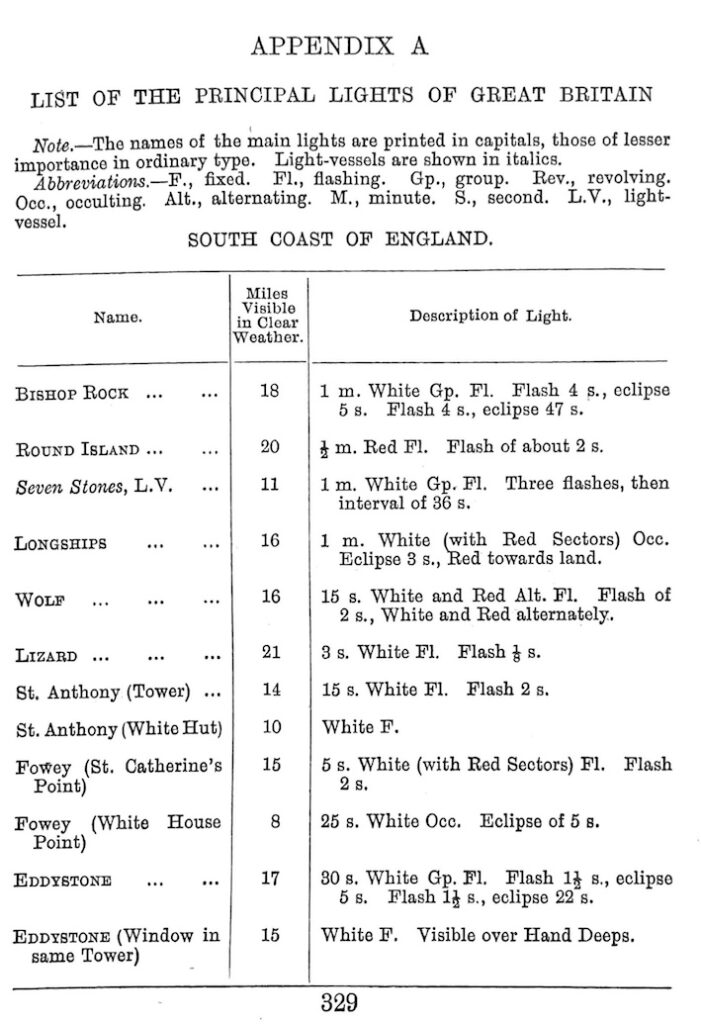
One of the questions we always ask visiting school parties is ‘What is a lightship’. Most of them get the answer right, or partly right; that a lightship is a floating lighthouse that warns ships at sea of hazards. Partly right? Yes, because they do much more than that. The light of each lightship (and lighthouse) has a unique flash pattern. The sequence of flashes of lights, and the pauses in between, tell the passing mariner where they are. They’re an aid to navigation as well.

Line drawing of initial design for LV50 by Bernard Waymouth

The original plans of LV50 and her light

Imagine you’re at sea, lost, you don’t know exactly where you are. You see a distant flashing light. If you look at a nautical chart (map) and you’ll find all the flash pattern codes for lights on the part of the coast where you are. Take a compass bearing on the light and you know you’re somewhere along the line of that bearing. See another light, or other landmark, and you’ve got an exact fix on your position.

List of the principal lights, including description of the light. See how complicated some of the flash patterns are, some even in colour.

So how did they get such a bright light shining out over the sea and how did they get it to flash?

One of the first lighthouses was designed by Henry Winstanley for the Eddystone lighthouse in 1699. This light used 60 candles. Candles created a lot of black soot which dimmed the light. In 1784 Amie Argand, a Swiss chemist, discovered that if you placed a clear glass cylinder around the flame it produced a clean, smokeless flame about 10 times brighter than a single candle. Unfortunately, at this time they used oil from whales as it burnt cleaner than other oils.

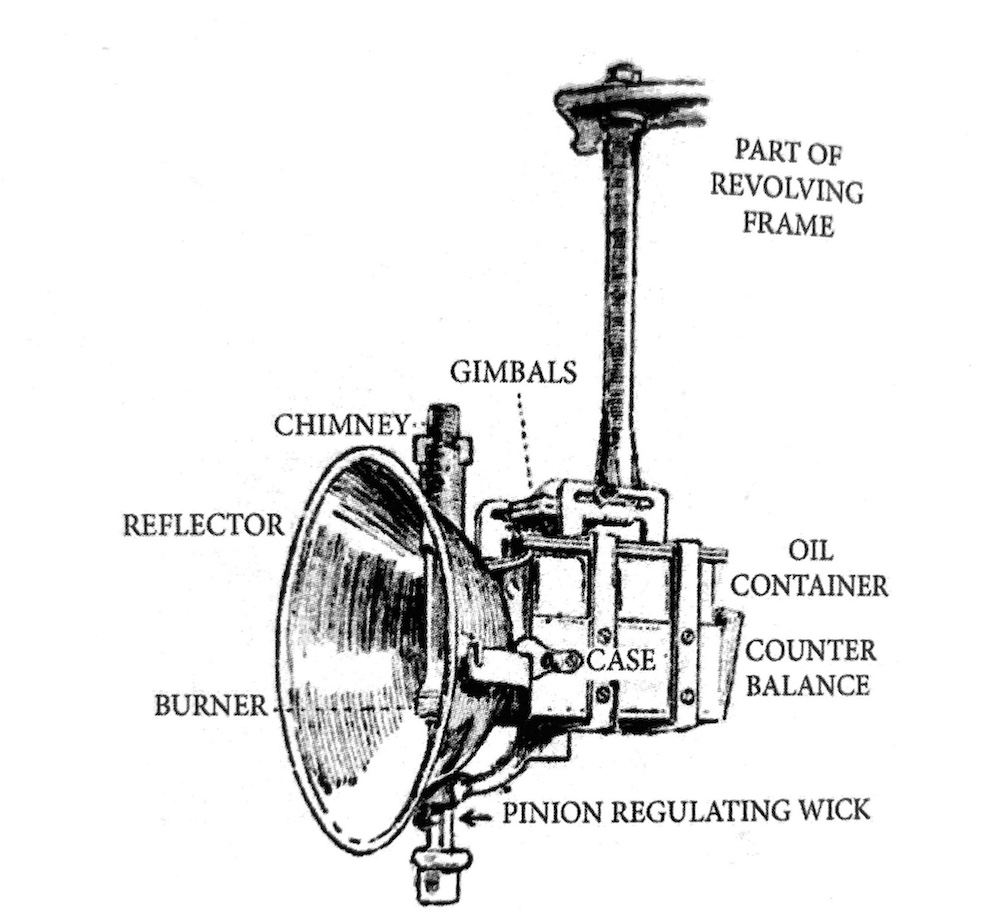
These technological improvement increased the light output a lot but the light from the lamp went equally in all directions, it wasn’t focused into a beam. The next technological invention was made by Robert Stevenson in the 1780’s. He focused the beam of light using a parabolic reflector made from silver plated copper hammered into shape. This, combined with the argan lamp, produced a light about 240 times brighter than a candle in a focused beam that could shine out over the sea. So how about making it flash?

Argan light and parabolic reflectors. Source: Lane & Augustus Lightships

Well, the light didn’t actually flash. The steadily burning lamp with their reflectors were mounted on a frame that rotates as the light shines. This gives the impression of flashing but really the beam shines out, sweeping around over the sea. The rotating light is then enclosed in a waterproof cover which has windows. The frame that the sets of lamps and reflectors are mounted on can be adjusted to control the apparent flash pattern so that the unique pattern can be programmed in but easily changed when the lightship changes location.

Figure 6 the chance brother's lantern similar to the one originally on LV50

A lightship lantern being tested at the manufacturers factory Source: Chance Brothers

All these technological achievements were made without electricity or steam power. What made the light rotate? The answer is clockwork. There was a large lead weight inside the mast that was wound up high and then allowed to slowly drop down, rotating the light through a series of cogs. Not too dissimilar from a grandfather clock except that you needed to wind it up every 30 minutes.

The focused light shining out in a steady beam, rotating to give the impression of flashing, visible over 10 miles away (on a clear night) wasn’t the only technological miracle. There was also the foghorn, but that’s another story.

If you’re interested in lightships there a lot more information on our website www.friendsoflv50.org.uk. If you prefer your information in a book why not try Anthony Lane and Martin Augustus’s new book, ‘Lightships Their Design, Development and Diversity’. Available from the publishers at https://www.amberley-books.com/lightships.html (you’ll also find it on Amazon).

Please leave a comment HERE

Notice of Friends of LV50 AGM for Year 2024

Header for Blog posts

Our AGM will be held by ZOOM on Thursday 27 March 2025 at 18:30 UK time.

If you are a member or would like to be one and you’d like to attend our AGM by ZOOM please send an email to friendsoflv50@gmail.com and we’ll send out an invitation in due course.

Leave a comment HERE

Fresh Water Supplies on LV50

Header for Blog posts

How much freshwater did LV50 carry

Fresh water has always been a major concern for seafarers. From the early explorers hoping down the coast of West Africa, looking for a way East, to the Royal Navy steaming around the world; fresh water has limited the amount of time ships can stay at sea. Light ships were no different; they had to stay on station no matter what the weather.
They were anchored up and with no motor relied on being resupplied with food and fresh water from shore, as and when the weather permitted. It’s likely that a lot of the water they drank was in tea. This used boiled water, which was safer, imagine the water sloshing around in iron tanks for months on end! The hot drink would also have warmed them, very welcome on a cold day.


During her service with Trinity House resupplying and changing crews must sometimes have been hazardous and at times best delayed. Fresh water transfer must have been tricky, having to keep the 2 boats on station while the water was pumped across. Therefore, fresh-water storage capacity was of great operational importance.


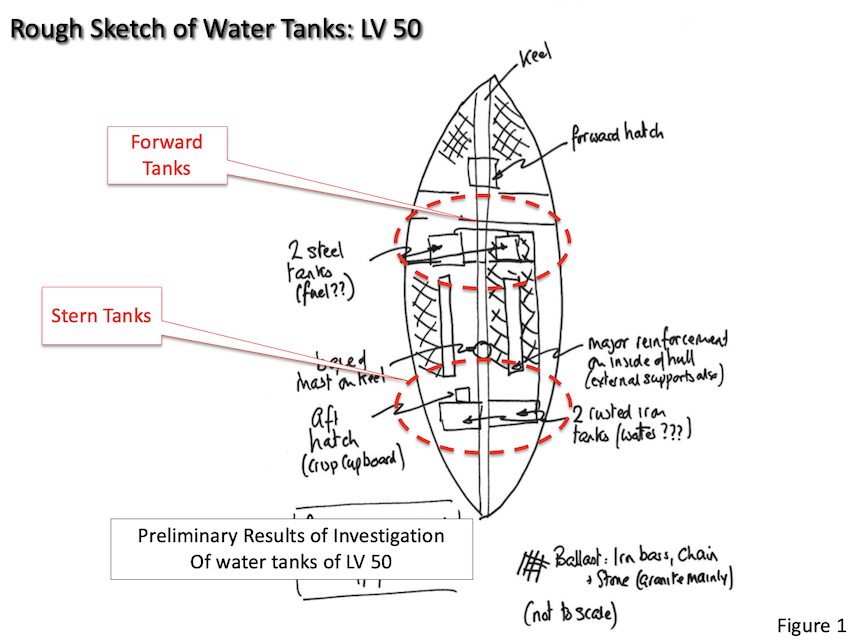
In their first look under the decks the Friends of LV50 Research Group identified 2 sets of tanks, the first underneath the forward part of the lounge and the second, aft, under the bar. The forward tanks were clearly more recent, being of welded steel rather than riveted iron plate of the aft ones. Following correspondence with Anthony Lane, author of one of the definitive books on light ships (Guiding Lights, The British Lightvessel from 1732, Tempus Publishing 2001), it was decided to venture under the decks again to better describe and survey these tanks.

A rough sketch of the position of the water tanks in LV50


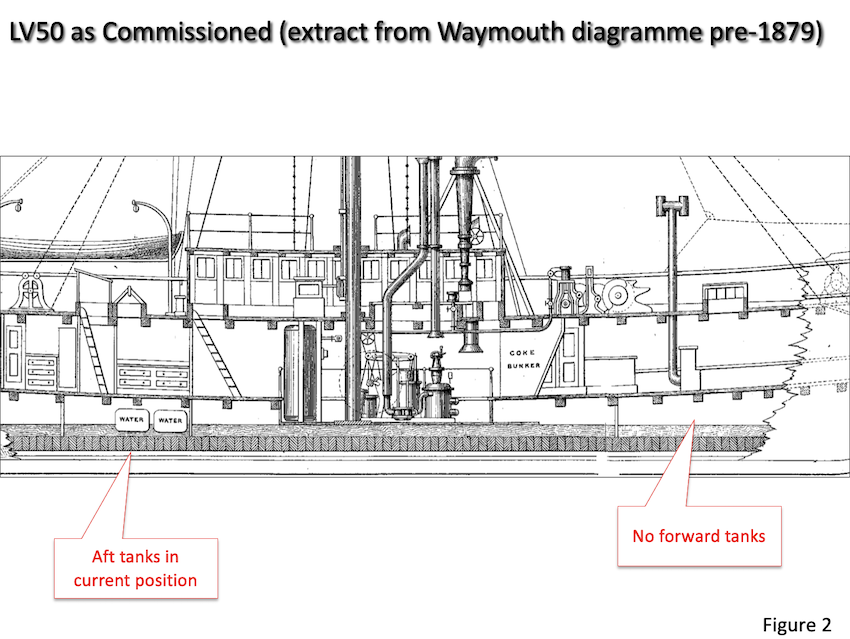
The initial plans for LV50 made by Bernard Weymouth. Note that only the stern (aft) tanks were planned.

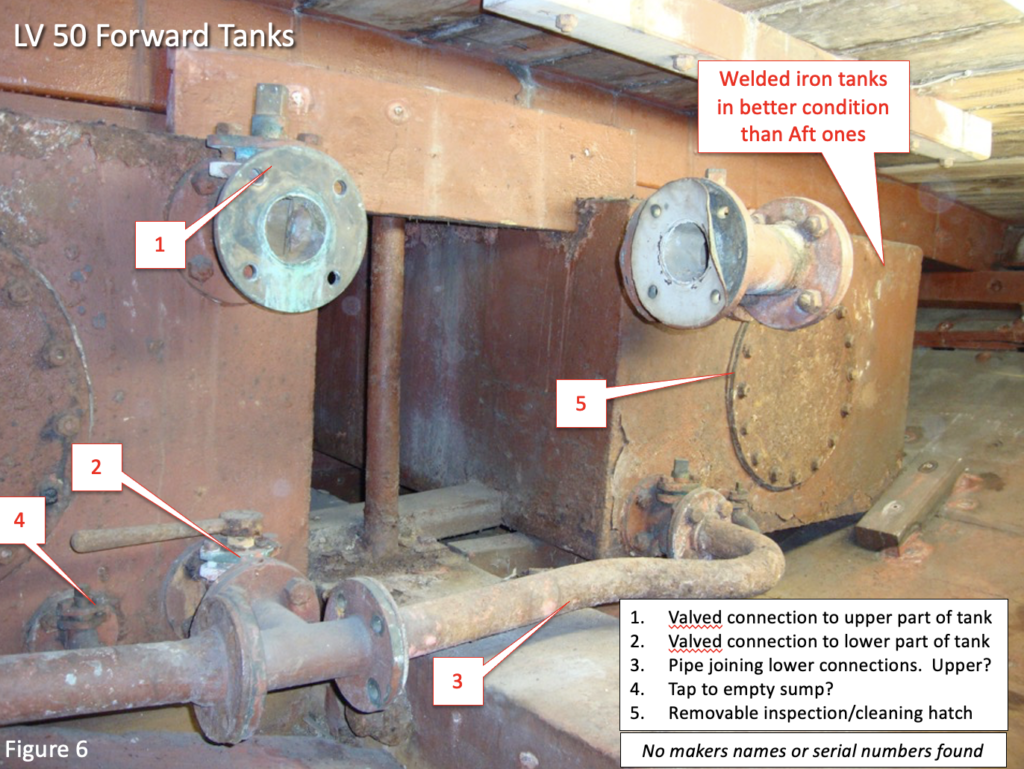
The forward tanks were accessed through the trapdoor in the deck of the forepeak, a relatively easy and well-lit passage. The two large, welded steel tanks are centrally located and occupy the whole height of the space available. They were photographed and measured. Each tank is 42” wide, 26” high and 54” deep, a rough calculation giving a maximum capacity each of 215 Imperial Gallons (975 liters) each. Various features were noted, including inspection hatches and a metal pipe extending from the tanks to the stern along the starboard side. The purpose of these tanks was confirmed when the inspection hatches were opened up. They are part filled with water, presumably fresh when it was put in there. When the tanks were installed is not known. On-going work by the research group indicate that LV50 had major overhauls around 1911 and 1935 which could have been when these forward tanks were fitted.

Survey of stern water tanks. fourth tank likely was present but removed later
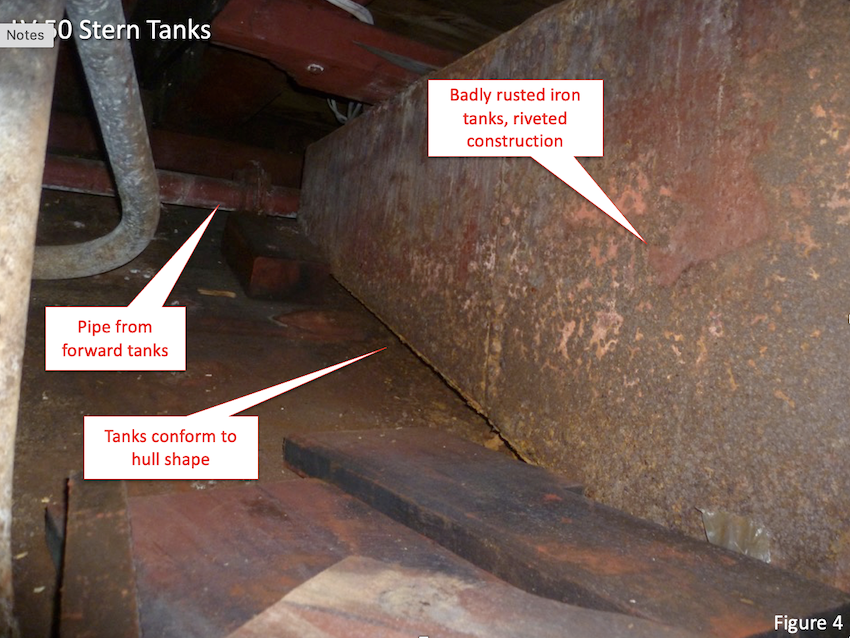
A photograph of the stern tanks. Note riveted sheet iron construction is very different from forward tanks.


The stern tanks were less easy to access through a small trapdoor in the floor of the ‘crisp cupboard’ beside the way into the bar. This tortuous access necessitated some gymnastics but was achieved sufficiently well to map out and measure the tanks. Three riveted iron tanks, rusted through in places, were examined. The place of a likely fourth tanks being taken by a large modern black plastic tank. The visible tanks are tapered to fit the hull shape and were likely original features, purpose built for the boat. These tanks appear on the ‘Waymouth’ drawings dating from the time of the boats commissioning, each tank is 51” wide, 47” deep and 27” tapering to 9” high, a rough calculation indicates that each tank could contain up to 195 Imperial Gallons (885 litres).

Survey of forward tanks. Note more complex ‘plumbing’ (see image below also)
A photograph of the forward tanks. Note welded steel construction and complex plumbing. Likely later than stern tanks.


In summary, LV50’s original aft fresh-water tanks could hold up to about 780 Gallons (if there was a fourth tank). It is likely that the 7-man crew needed 1-2 Gallon a day per person; assuming washing etc. was done with sea-water. This would have meant that the crew could originally have lasted roughly up to 50-100 days between replenishments. This capacity was later augmented with an additional 430 Gallons to give a total 1210 Gallons. Using the same calculation this could have lasted 85-170 days. This is very much of a rough calculation, which could be considered a maximum case.


Thanks to the work of Anthony Lane it is clear that Trinity House consistently increased the fresh-water capacity of their lightships. LV50 had about 800 Gallon tank capacity (1879), LV55 had 1000 Gallons, LV61 1600 Gallons and LV91 (1937) could hold an impressive 5000 Gallons. The early 1900’s upgrade of fresh-eater storage capacity to 1210 Gallons, in this context, appears logical; the remaining big question is when it was carried out.

Leave a comment HERE

Change is Coming Here!

Header for Blog posts

New Year – New Look Website

Our website has been going for quite a few years now and needs a re-vamp to bring it up to date. Things will be moving around to make it easier for you to find things and understand how we work.

We don’t want to take the site ‘down’ while we’re doing this so we’ll be working away behind the scenes to make the site better. Unfortunately, there might be time when our tinkering is a bit more visible or the site is a bit slower than usual.

Please bear with us, it’ll be all right at the end and of course, ‘if it isn’t all right it isn’t the end’.


Happy New Year to all our readers

Leave a comment HERE

A Christmas Treat from Blyth’s Lightship

Header for Blog posts

Seven Stones to Blyth Audiobook

Come aboard and meet John on his first day aboard LV50, The Seven Stones Lightship. Let his mate Christopher, who is definitely not an early bird, be your guide around the ‘Ship of the Future’.

Follow their life of service to light the seaways and keep ships safe at sea. At the end, as John took his last breath, the sound of the foghorn still sounded in his head, and the smell of the sea still stung his nostrils.


Was it the end?


Is LV50 really haunted?

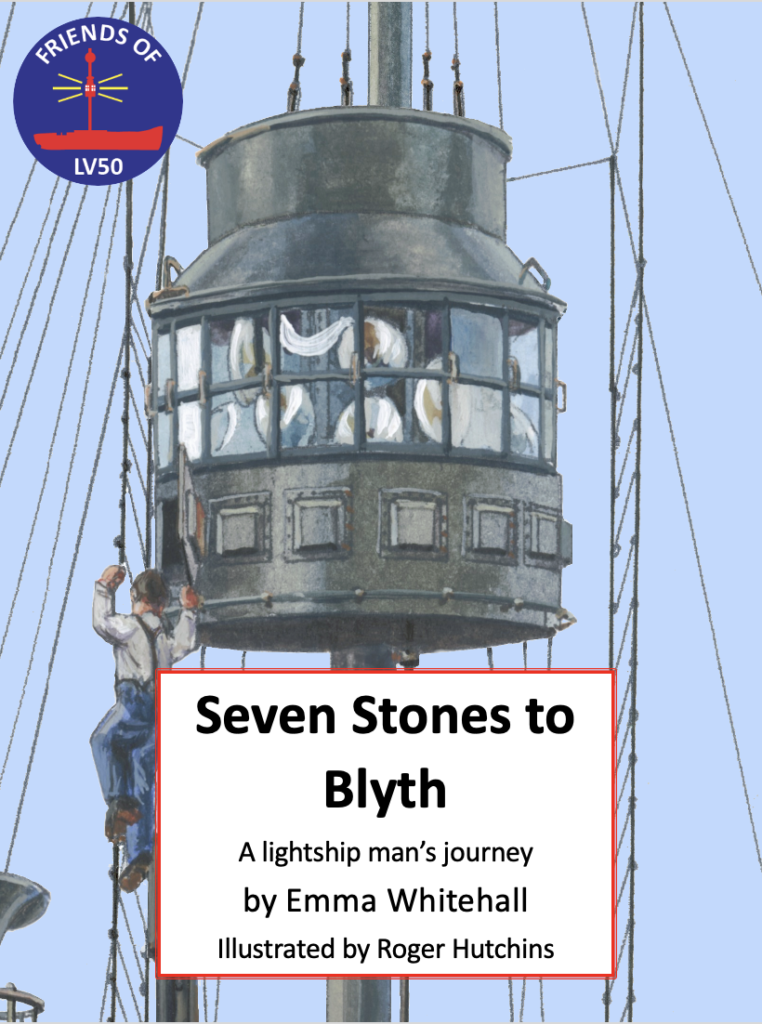
Seven Stones to Blyth A lightship man's journey Book by LV50


If you’ve not read the book you can listen to the storybook version now using our audio player below. Chris Jackson and friends have put together a full ‘theatrical’ version of the book to bring it even more to life. Using the LV50 shanty by Gabriel Walker Chris and the cast tell the story of John and LV50 on their journey to Blyth and ‘beyond’.

Audiobook version of ‘Sevenstones to Blyth’ book


Sit back and enjoy, it’s a real treat.


Merry Christmas to all our readers


Credits
‘Seven Stones to Blyth – A lightship man’s journey’ was written by Emma Whitehall.
John was played by Lawrence Neale,
Christopher by Chris Iddon
Arthur O’Cooke by Chris Connel
and Lily by Eleanor Grainger
with all other roles played by the cast.
It was narrated and produced by Chris Jackson.
The LV50 sea shanty was written and performed by Gabriel Walker.

Leave a comment HERE

The Blyth Lightship Blog Arrives

Header for Blog posts

Winter’s arrived and visits, apart from pre-arranged ones, and open days are over for the moment. No rest for the wicked though. We’ve taken a fresh look at our website and it’s looking a bit tired. So we’re giving it a going over. Not sure how it’ll go since we are not exactly experts but help is at hand. Stef Simpson and the Blyth CVA are there to help us, thanks guys.

As part of the new look website we’re starting a blog on all things LV50 and Lightships. We’ll be posting a new story each month and have plenty of ideas about what we’d like to post. However, if there’s anything you’re interested in let us know and we’ll see what we can do.

Leave a comment HERE

The LV50 Shanty is here

Header for Blog posts

An amazing video of LV50 Shanty, with lightship related video set to the music of our sea shanty. It’s part of our cooperation with local schools and we play it to the students at every visit.

The words are by Harriet Palin, set to music and sung by Gabriel Walker

Leave a comment HERE