

How much freshwater did LV50 carry
Fresh water has always been a major concern for seafarers. From the early explorers hoping down the coast of West Africa, looking for a way East, to the Royal Navy steaming around the world; fresh water has limited the amount of time ships can stay at sea. Light ships were no different; they had to stay on station no matter what the weather.
They were anchored up and with no motor relied on being resupplied with food and fresh water from shore, as and when the weather permitted. It’s likely that a lot of the water they drank was in tea. This used boiled water, which was safer, imagine the water sloshing around in iron tanks for months on end! The hot drink would also have warmed them, very welcome on a cold day.
During her service with Trinity House resupplying and changing crews must sometimes have been hazardous and at times best delayed. Fresh water transfer must have been tricky, having to keep the 2 boats on station while the water was pumped across. Therefore, fresh-water storage capacity was of great operational importance.
In their first look under the decks the Friends of LV50 Research Group identified 2 sets of tanks, the first underneath the forward part of the lounge and the second, aft, under the bar. The forward tanks were clearly more recent, being of welded steel rather than riveted iron plate of the aft ones. Following correspondence with Anthony Lane, author of one of the definitive books on light ships (Guiding Lights, The British Lightvessel from 1732, Tempus Publishing 2001), it was decided to venture under the decks again to better describe and survey these tanks.
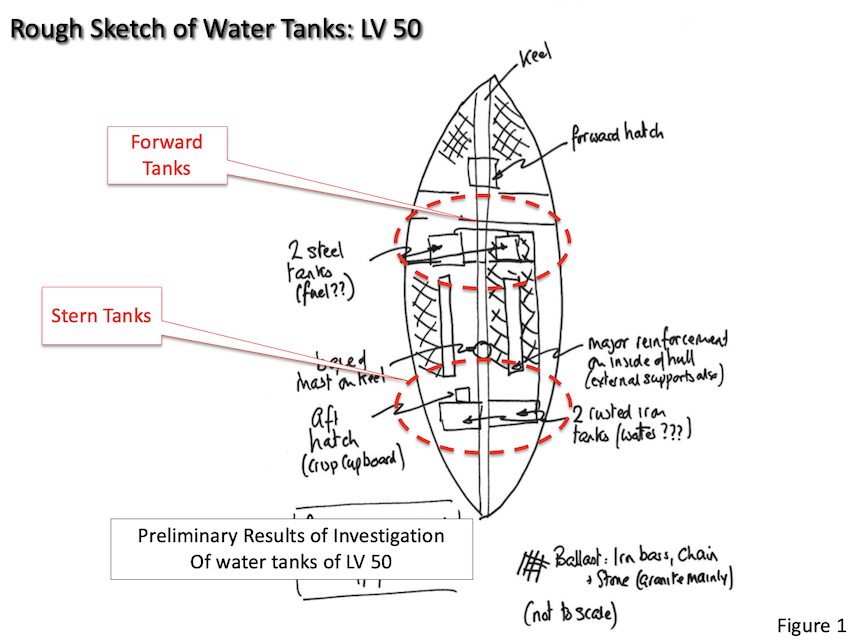
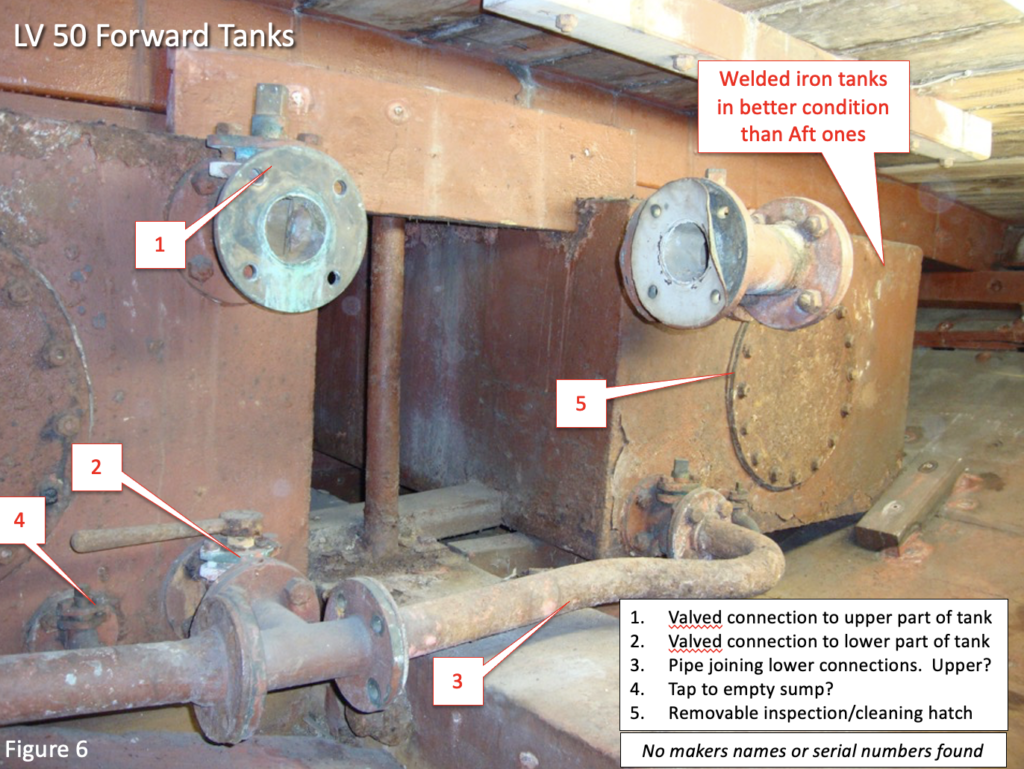
The forward tanks were accessed through the trapdoor in the deck of the forepeak, a relatively easy and well-lit passage. The two large, welded steel tanks are centrally located and occupy the whole height of the space available. They were photographed and measured. Each tank is 42” wide, 26” high and 54” deep, a rough calculation giving a maximum capacity each of 215 Imperial Gallons (975 liters) each. Various features were noted, including inspection hatches and a metal pipe extending from the tanks to the stern along the starboard side. The purpose of these tanks was confirmed when the inspection hatches were opened up. They are part filled with water, presumably fresh when it was put in there. When the tanks were installed is not known. On-going work by the research group indicate that LV50 had major overhauls around 1911 and 1935 which could have been when these forward tanks were fitted.

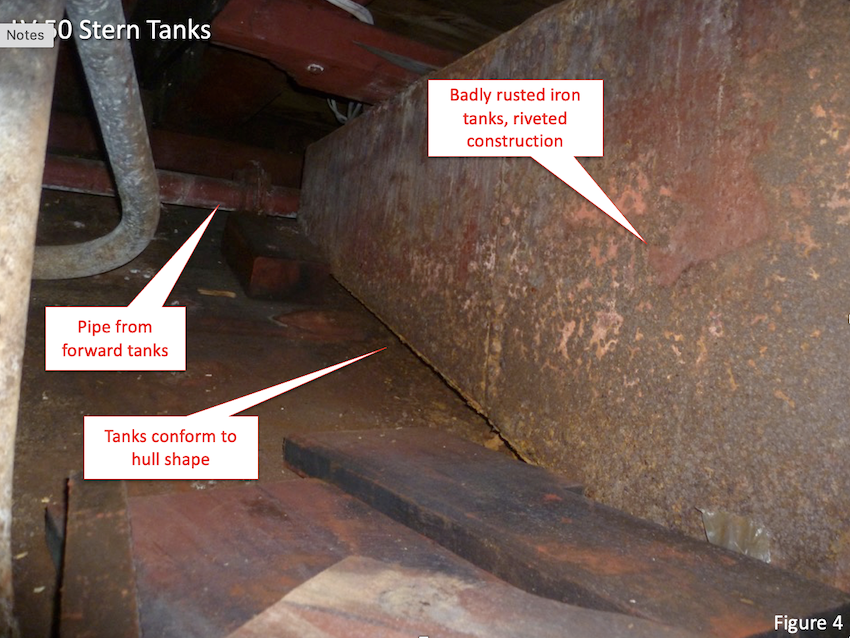
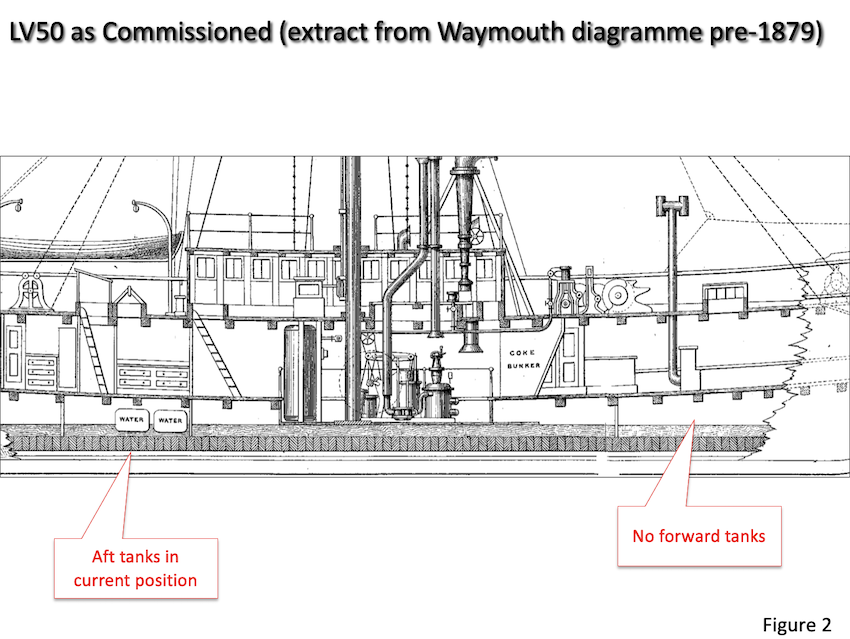
The stern tanks were less easy to access through a small trapdoor in the floor of the ‘crisp cupboard’ beside the way into the bar. This tortuous access necessitated some gymnastics but was achieved sufficiently well to map out and measure the tanks. Three riveted iron tanks, rusted through in places, were examined. The place of a likely fourth tanks being taken by a large modern black plastic tank. The visible tanks are tapered to fit the hull shape and were likely original features, purpose built for the boat. These tanks appear on the ‘Waymouth’ drawings dating from the time of the boats commissioning, each tank is 51” wide, 47” deep and 27” tapering to 9” high, a rough calculation indicates that each tank could contain up to 195 Imperial Gallons (885 litres).

In summary, LV50’s original aft fresh-water tanks could hold up to about 780 Gallons (if there was a fourth tank). It is likely that the 7-man crew needed 1-2 Gallon a day per person; assuming washing etc. was done with sea-water. This would have meant that the crew could originally have lasted roughly up to 50-100 days between replenishments. This capacity was later augmented with an additional 430 Gallons to give a total 1210 Gallons. Using the same calculation this could have lasted 85-170 days. This is very much of a rough calculation, which could be considered a maximum case.
Thanks to the work of Anthony Lane it is clear that Trinity House consistently increased the fresh-water capacity of their lightships. LV50 had about 800 Gallon tank capacity (1879), LV55 had 1000 Gallons, LV61 1600 Gallons and LV91 (1937) could hold an impressive 5000 Gallons. The early 1900’s upgrade of fresh-eater storage capacity to 1210 Gallons, in this context, appears logical; the remaining big question is when it was carried out.
Leave a comment HERE